What Affects Name Card Printing Prices in Singapore
Most printers in Singapore quote on request rather than publishing a price list. That makes it hard to tell whether a quote is reasonable, and harder still to decide how many to order.
Understanding what actually drives the cost makes both easier. There are only four variables that matter, and once you know how each one behaves you can read any quote properly.
What a box means
A box is 100 cards. Quantities are almost always discussed in boxes rather than in cards, and prices are quoted per order rather than per card.
Converting a quote to a cost per card is the single most useful thing you can do before comparing suppliers, because it is the only figure that makes two different quantities comparable.
Quantity is the biggest lever
The cost per card does not fall evenly as you order more. It falls steeply at first and then flattens.
Going from one box to two makes a substantial difference per card. Going from two to three makes a further, smaller difference. Beyond about three boxes, the per-card cost is largely flat, and ordering five or ten boxes buys you more cards at roughly the same rate rather than a better rate.
This matters because the instinct to "order more and save" only holds up to a point. Past that point you are not saving, you are simply buying more.
The practical consequence is that the meaningful decision is between one box and three, not between five and ten. If you are hesitating over a second box, the second one usually costs far less than the first did.
Where a single box still makes sense is when the design is likely to change. A new hire who may be promoted, a company still adjusting its branding, or anyone testing a layout is better off with 100 cards than 1,000 that become obsolete.
Digital or offset, and why the curves differ
The two printing methods have completely different cost structures, which is why the right answer changes with quantity.
Digital printing has no plate set-up. The file goes to the press and prints. That means there is no large fixed cost to spread, so a small run stays cheap and a single box is viable. It also means the cost per card improves more gently as quantity rises, because there was never a big setup cost to dilute.
Offset printing requires plates to be made before anything prints. Those plates cost money whether you print 200 cards or 2,000. Once they exist, each additional card is very cheap. So offset starts expensive and gets cheaper per card faster than digital does, which is why it wins at volume and cannot compete at one box.
Offset also holds colour more consistently across a long run, which matters when a logo uses a specific corporate colour and the cards are being distributed by a whole team.
The trade is speed and minimum order. Offset takes longer and cannot produce a single box.
A simple rule. One box, or you need them quickly, use digital. Two boxes or more and you can wait, ask for an offset price as well before deciding.
Paper stock
Paper is where most of the perceived quality of a card comes from, and the difference between the cheapest and dearest option is usually a few dollars a box rather than anything dramatic.
Four broad categories are common in Singapore:
Gloss art card, typically around 260gsm. A shiny surface, slightly off white. Colours sit brightly on it, which suits cards with a full colour background or a photographic element.
Matt white, typically around 300gsm. A matt surface on a genuinely white base. Heavier than art card and the more conventional corporate choice. Matt does not reflect under office lighting, which makes text easier to read.
Textured stock, often a linen finish around 250gsm. You notice this one when you hand it over rather than when you look at it.
Shimmering stock, around 290gsm. A subtle sheen across the surface. The most decorative of the four.
Weight and finish are separate things. A 250gsm textured card can feel more substantial than a 300gsm smooth one, because texture reads as quality to the hand even at a lower weight.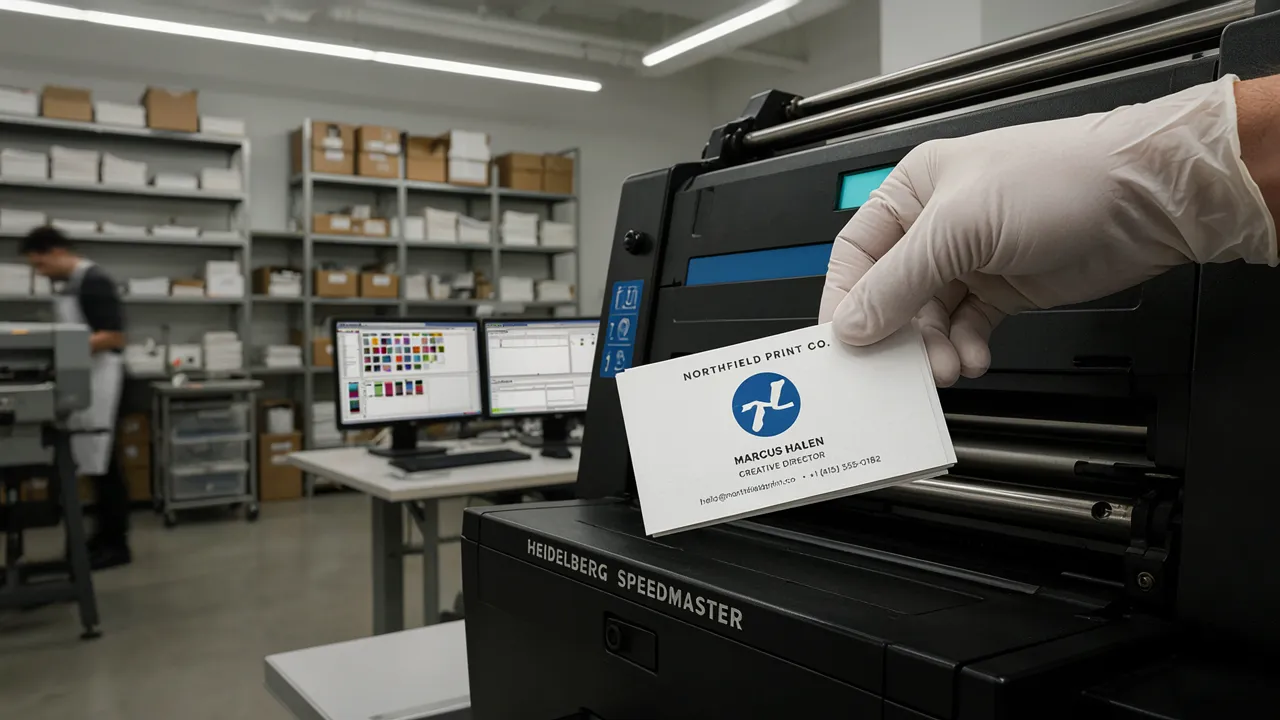
Single or double sided
Double sided costs more, and the gap is proportionally largest at small quantities.
Whether it is worth it depends entirely on whether you have something to put there. A reverse side carrying a QR code, a second language, a short service list or a map earns its cost. A reverse side carrying a repeated logo does not.
How to compare two quotes properly
Four things make quotes comparable:
Convert both to cost per card. Divide the total by the number of cards. Quantities are rarely identical between quotes.
Check whether both are the same printing method. A digital quote and an offset quote at the same quantity are not measuring the same thing.
Check the paper weight and finish. A cheaper quote on 250gsm against a dearer one on 300gsm is not a like-for-like comparison.
Check whether GST is included. A supplier who is not GST-registered quotes a final figure. One who is will add 9% at invoicing, which can reverse the ranking between two close quotes.
Ask for both a digital and an offset price when your quantity sits near the boundary. Most suppliers will provide both, and the comparison often surprises people.
Standard Singapore name card size is 90mm by 54mm. Current stock options and quantities are on the digital name card printing page.